

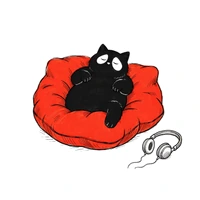
Make room for rest between focus sessions
Treat break time as room to recover, not another performance contest
The alarm goes off. You said five minutes, so you pick up your phone. You check a notification, open one thing, and open another thing from there. You look up and 25 minutes are gone, and it doesn't feel like you rested.
Break time is hard, but not because your willpower is weak. It's because you set the focus time and left the break time unset. Unclaimed time fills with the default, and these days the default is a phone.
Change what the break is for
It's better to get your expectations right first. In a meta-analysis of 19 studies covering 2,335 people, breaks of 10 minutes or less raised vigour (d=.36) and lowered fatigue. Both effects were small but clear.
The improvement in performance, though, was not statistically significant (d=.16). It's hard to promise that resting makes the next focus session go better.
So if you treat rest as an investment in the next session, it will keep disappointing you. The point of rest is simply to be less worn out. That's reason enough on its own.
What you do with it matters quite a lot
A phone restores less
In a randomised experiment splitting 414 people into four conditions, the people who spent their break on a phone solved the following task more slowly and solved fewer of them than people who rested with paper or a large screen.
Not because phones are bad, but because that shape isn't rest. A screen keeps handing you new information, and your head keeps processing it.
Actually resting works better
You often hear that doing some other light task during a break clears your head. The research leans the other way.
In a study made up of two experiments, performance after an interruption was best in the complete rest condition and worst in the condition that carried straight on without a break. Doing a different cognitive task in between landed somewhere in the middle. Another study found that switching briefly to a different goal did nothing at all to undo the drop in attention.
Move your body, look outside
In an experiment with 150 university students, the group that looked at a photo of a flowering roof garden for just 40 seconds made fewer misses on a task than the group who looked at bare concrete. Other classic studies have also found that simply looking at nature improves attentional control.
In a study where people took a 15-minute park walk at lunch for ten days, afternoon focus rose and fatigue fell. A group doing relaxation exercises also reported less tension and fatigue.
Often, briefly, early
A study that followed 95 office workers for five days found recovery was greatest under three conditions.
- When it was something the person enjoyed
- When the break came early in the workday
- When breaks were short and frequent rather than occasionally long
Which means resting briefly while you're still fine beats holding out until you're wrecked.
Try this
| In your five-minute break | Try this |
|---|---|
| Your hand goes to your phone | Leave the timer running and walk away from the desk. Leave the phone |
| You don't know what to do | Look out of the window. Even 40 seconds showed a signal |
| You rest and can't come back | Leave a one-line return point before you stop |
| Resting feels like a waste | Put the break on the plan as a thing to do |
| Resting doesn't help | Stretch it to 15 minutes and go outside |
Build the way back in advance
Harder than resting is coming back. Before you stop, leave one line — "I got this far, next is this" — and you won't have to work it out again when you return. That's in Returning to a task after an interruption.
If deciding on break time every time is a nuisance, you can hang it off something you already do. See Attach a routine to something you already do.
In TodoMato
Run the focus timer as Pomodoro rounds and the rest slots come in alongside the focus slots. You don't have to remember the break side separately.
When the time is up it tells you "this much is already enough." It doesn't ask for more. And it doesn't count how many days in a row you've managed — so a day of rest isn't a mark against you. Choosing the focus interval itself is covered in Does a Pomodoro have to be 25 minutes?
If symptoms are distressing or interfere with daily life, speak with a qualified professional.
Sources for this article
- "Give me a break!" A systematic review and meta-analysis on the efficacy of micro-breaks — PLOS ONE
- Reach for your cell phone at your own risk: the cognitive costs of media choice for breaks — Journal of Behavioral Addictions
- Rest is best: the role of rest and task interruptions on vigilance — Cognition
- Effects of breaks and goal switches on the vigilance decrement — Experimental Brain Research
- 40-second green roof views sustain attention: the role of micro-breaks in attention restoration — Journal of Environmental Psychology
- The cognitive benefits of interacting with nature — Psychological Science
- Enhancing daily well-being at work through lunchtime park walks and relaxation exercises — Journal of Occupational Health Psychology
- Give me a better break: choosing workday break activities to maximize resource recovery — Journal of Applied Psychology