

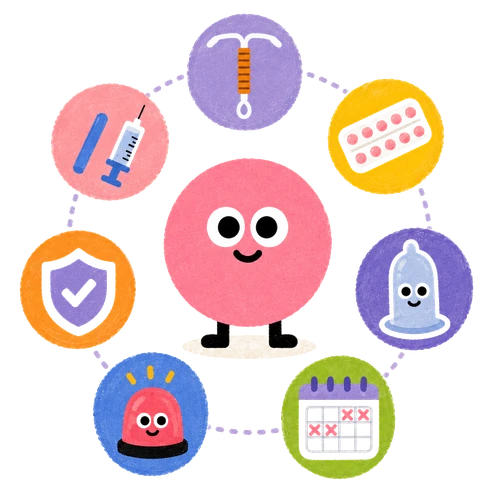
A guide to birth control
The gap between methods is bigger than you'd think
Methods differ in how well they work, and the gap is bigger than you'd think. It is widest between the ones placed once that last years and the ones you have to keep up with every day. Let's start with what differs, and why.
Think in "how many out of 100 in a year"
Counting people is clearer than percentages.
Every number here is for how people actually use each method — forgotten days and late appointments included. Followed exactly as directed each one does better, but this is what it looks like in real life.
| Method | Pregnancies per 100 in a year |
|---|---|
| IUD or implant | Fewer than 1 |
| Injection | 6 |
| Pill, patch, or ring | 9 |
| Condoms | 18 |
| Tracking dates, temperature, or mucus | 12–24 |
The methods that last years once placed are about twenty times more effective than the ones you keep up with daily. Not because the hormones are stronger, but because there is nothing to remember each day.
How each one is used
- Pill — one at the same time every day
- Patch — a new one each week for 3 weeks, then a week off
- Vaginal ring — in for 21 days, out for 7
- Injection — once every 13 weeks
- Implant — placed under the skin of the upper arm, for up to 5 years
- IUD — fitted at a clinic, for 3 to 10 years. It comes in copper and hormonal versions
- Internal condom — can be put in up to 8 hours before sex
If you are curious about the IUD, there is more in About the IUD.
Questions to ask yourself
Can you keep up with something daily? If not, an implant or IUD — set once and left alone — tends to suit better. Most of the gap in the numbers above comes from this.
Do you also need STI protection? Only condoms protect against sexually transmitted infections. Use them alongside whatever else you are on if you need that.
When might you want to get pregnant? How quickly fertility returns after stopping differs by method. After the injection it takes about 10 months on average.
Do you have a health condition or take other medication? Hormonal methods are not right for everyone.
When a method might not suit you
Methods with estrogen (the pill, patch, and ring) are not recommended if any of these apply to you.
- You are over 35 and smoke more than 15 cigarettes a day
- You have had a stroke, a heart attack, or a blood clot
- You get migraines with aura
None of that means you cannot use birth control. There are methods without estrogen, so bring it up at your appointment.
What aura actually is, and why it is singled out, is covered in Menstrual migraine: when headaches follow your cycle.
A fertile window is not birth control
The fertile window and ovulation dates in this app are estimates calculated from your past cycles.
Stress, sleep, or a weight change alone can move ovulation by days. That is why this method sits highest in the table above, at 12–24 out of 100. If your goal is preventing pregnancy, you must use another method.
Why predictions drift is in When do you ovulate, how long are you fertile?.
If you had sex without contraception
The sooner the better. The pill has to be taken within 72 to 120 hours at the latest, and in the US levonorgestrel pills (such as Plan B) are sold over the counter with no age limit. It is not a substitute for a regular method.
More on it in If the condom broke.
Common questions
Which one works best? The IUD and the implant. Fewer than 1 in 100 people in a year, because there is nothing to remember each day.
I missed a pill. It depends on when you missed it. Check the instructions that came with your pills first, and use condoms for the rest of that cycle.
Can I use condoms alone? You can. The number is on the higher side, though — 18 out of 100 in a year — and since condoms are the only thing that protects against STIs, many people pair them with another method.
Can I get pregnant right after stopping? It depends on the method. The injection takes about 10 months on average; the IUD and the pill are quicker than that.
Keeping track in LunaCat
Settings › Current situation
If you use hormonal birth control, choose "I'm on hormonal birth control". We will show you a note that ovulation is suppressed, so predictions may not match your body.
Noting the day you started and the day you switched makes it easier later to see whether a change in your body lines up with a change of method.
This article is for information only. Talk to a health professional about decisions for your body.
Sources
- Birth Control — ACOG
- Long-Acting Reversible Contraception (LARC): Intrauterine Device (IUD) and Implant — ACOG
- Progestin-Only Hormonal Birth Control: Pill and Injection — ACOG
- Combined Hormonal Birth Control: Pill, Patch, and Ring — ACOG
- Barrier Methods of Birth Control — ACOG
- Fertility Awareness-Based Methods of Family Planning — ACOG